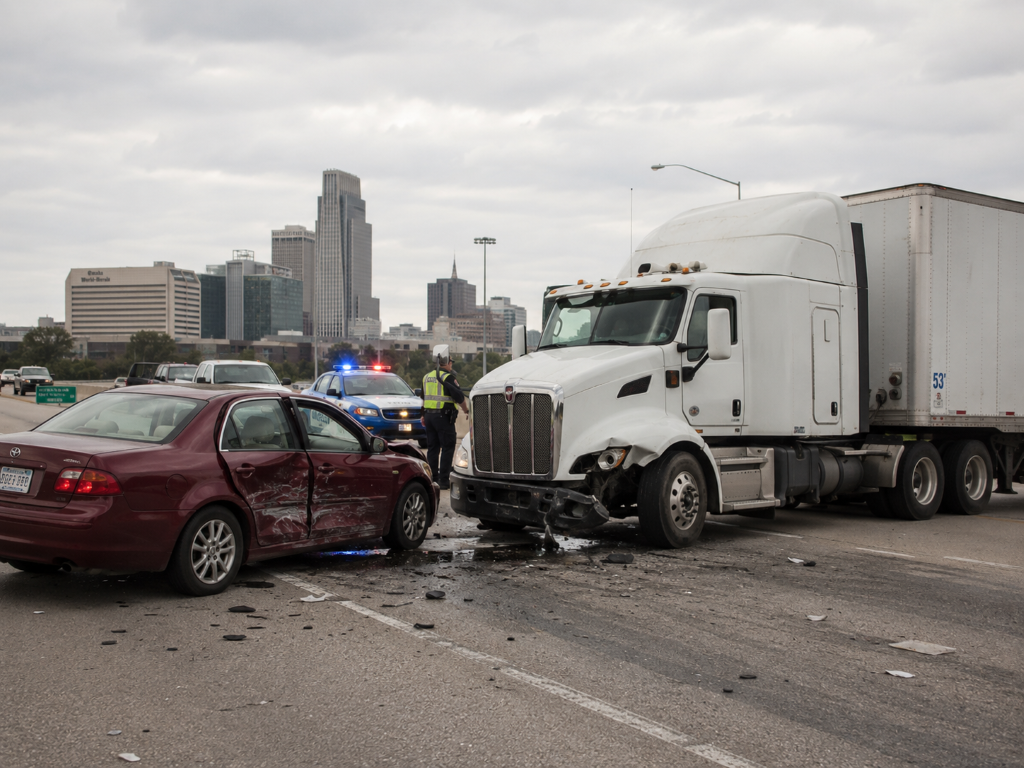
When a large commercial truck crashes on I-80 or through the streets of Omaha, the cause is rarely a mystery. Trucking accidents often stem from something preventable, such as a driver who was too tired to be behind the wheel. Understanding how the federal trucking regulations work, and what happens when companies break them, can make a real difference if you are ever involved in a crash with an 18-wheeler.
What Are FMCSA Hours-of-Service Rules and Why Do They Matter?
The Federal Motor Carrier Safety Administration (FMCSA) is the federal agency that sets safety standards for the trucking industry. One of its most important tools is the hours-of-service rule, a set of regulations that limits how long a commercial truck driver can drive before resting.
These rules exist for one simple reason: driver fatigue is a leading cause of serious truck accidents. A driver who has been awake for 20 or more hours reacts to danger about as slowly as someone legally drunk. On a highway shared with passenger cars, that level of impairment endangers everyone.
How Many Hours Can a Driver Legally Work?
Under current FMCSA regulations, most drivers of a commercial motor vehicle carrying property are limited to 11 hours of driving after 10 consecutive hours off duty. They cannot drive beyond the 14th hour after coming on duty, even if they have not used all 11 driving hours.
There is also a weekly cap. Drivers cannot exceed 60 hours on duty in 7 consecutive days, or 70 hours in 8 consecutive days. Once a driver reaches that limit, they must take at least 34 consecutive hours off before starting a new cycle.
What Is the 30-Minute Break Requirement?
Drivers who have been on duty for more than 8 cumulative hours without at least 30 minutes off duty must take a mandatory break before continuing. This rule is designed to interrupt long stretches of continuous driving that build fatigue slowly.
Short breaks like stopping for fuel do not count unless the driver is completely off duty for the required time. The break must be genuine rest, not a quick stop that continues the physical and mental strain of working.
How Are These Hours Tracked?
Most commercial drivers must now use an electronic logging device, or ELD. This device automatically records driving time, on-duty time, engine hours, and location data. Before ELDs became mandatory, paper logbooks were the standard, and they were far easier to falsify.
Logbook violations, whether on paper or digital, are a serious red flag. When a carrier or driver manipulates records to hide excess driving time, that deception can become critical evidence in a personal injury case.

How Do Hours-of-Service Violations Lead to Truck Accidents?
The connection between rule violations and crashes is not complicated. When a driver pushes past legal limits, the risk of a drowsy driving crash rises sharply. Fatigue impairs judgment, slows reaction time, and can cause a driver to drift out of their lane or miss hazards entirely.
These accidents are especially dangerous because of the size and weight of the vehicles involved. A fully loaded semi-truck can weigh up to 80,000 pounds. When a fatigued driver loses control of that kind of mass, the results are often catastrophic.
Signs of Fatigue in Crash Investigation
After a serious trucking accident in Omaha, investigators look for specific signs that driver fatigue played a role. These include:
- No skid marks before impact, suggesting the driver did not brake
- Crashes that occur in the early morning hours when drowsiness peaks
- A driver who cannot clearly recall the moments before the collision
- ELD data showing continuous driving that exceeded legal limits
Each detail helps build a picture of what happened and why. Physical evidence combined with electronic records can clearly show whether a driver was in violation at the time of the crash.
How Violations Connect to Legal Liability
When an hours-of-service violation is documented, it significantly changes the legal picture. The violation itself is not just a traffic infraction. It is evidence that a federal safety rule was broken and that the driver operated in a dangerous condition the law was specifically designed to prevent.
In a personal injury case, showing that a federal trucking-regulation accident occurred because of a known, documented violation strengthens the argument that the crash was not simply bad luck. It resulted from a choice made by the driver, the carrier, or both.
What Evidence Matters Most?
The strongest evidence in these cases usually comes from the truck itself. ELD records, GPS data, fuel receipts, and dispatch logs can all reveal how long a driver was on the road before the crash. Securing this data quickly matters because some records are only kept for a limited time.
Witness accounts, dashcam footage, and police reports also play an important role. Together, these sources help reconstruct the hours leading up to the collision.
What Happens When a Carrier Ignores Federal Trucking Regulations?
Drivers do not always act alone when violations occur. Trucking companies sometimes create schedules that make it nearly impossible for drivers to stay within legal limits. When a carrier pressures drivers to skip rest, falsify records, or meet unrealistic deadlines, the company shares responsibility for any resulting crash.
This is where carrier liability becomes central. Under federal law, carriers must ensure their drivers comply with FMCSA regulations. Ignoring this responsibility does not shield a company from accountability. In many cases, it worsens their exposure.
Common Ways Carriers Create Dangerous Conditions
Some carriers cut corners in ways that are easy to miss until something goes wrong. Common patterns include:
- Setting delivery windows that are only achievable by skipping required breaks
- Failing to review ELD data for signs of hours violations
- Allowing drivers with a history of logbook violations to continue working without correction
- Pressuring drivers verbally or through dispatch systems to stay on the road
When these patterns come to light during litigation, they can significantly affect a claim’s outcome.
Maintenance Failures That Compound the Risk
Hours-of-service problems do not exist in isolation. Federal trucking regulations also require carriers to maintain their vehicles in safe operating condition. Fatigued drivers behind the wheel of a truck with worn brakes, bad tires, or faulty lights face compounding risks that multiply the chance of a serious crash.
A carrier that ignores both driver fatigue rules and vehicle maintenance requirements creates a far more dangerous situation than either problem alone. Both types of violations can be pursued in a single legal action.
What We Look for When Investigating These Cases
At Abboud Law Firm, we examine the full picture when a client comes to us after a trucking accident. We may request ELD records, maintenance logs, driver qualification files, and FMCSA carrier safety ratings. We may also look at whether the carrier has a pattern of violations that federal regulators have already documented.
This thorough approach matters because trucking companies and their insurers are experienced at defending these claims. Building a strong case requires real evidence, not assumptions.
Understanding a federal trucking regulations accident is the first step toward knowing your rights. We work with Omaha residents hurt by negligent drivers and irresponsible carriers, helping them understand what the law provides and how the evidence applies to their situation.
Frequently Asked Questions
How do FMCSA hours-of-service violations affect a truck accident claim in Omaha?
An hours-of-service violation is direct evidence that a federal safety rule was broken before the crash. This can support a negligence claim against the driver or the carrier by showing that the dangerous condition, meaning driver fatigue, was both foreseeable and preventable under existing law.
Can a trucking company be held responsible if their driver violated federal trucking regulations?
Carriers have a legal duty to enforce FMCSA compliance among their drivers. When a company creates schedules that encourage violations, fails to review electronic logging data, or ignores a driver’s history of hours violations, that company can face direct liability alongside the driver involved in the crash.
What should I do to preserve evidence after a trucking accident?
Preserve as much as you can from the scene, including photos, witness contact information, and a copy of the police report. The carrier holds ELD data, dispatch records, and maintenance logs, and you must formally request them through legal channels, often before they are overwritten or destroyed.