When freight is packed incorrectly or strapped down too loosely, even a skilled driver can lose control of a fully loaded 18-wheeler at highway speed. I-80 truck accidents in Omaha happen for many reasons, but cargo violations are among the most preventable and the most destructive. Understanding how improper loading leads to crashes can help you make sense of what happened and who should be held accountable.
I-80 runs directly through the heart of Omaha, carrying a constant stream of commercial freight moving between coasts. That volume of truck traffic creates real risk for everyone sharing the road. When a load shifts unexpectedly on a busy highway corridor, the consequences can be catastrophic.
How Does Unsecured Cargo Cause a Truck Accident Near Omaha?
Physics works against an overloaded or poorly secured trailer the moment something goes wrong. A sudden lane change, a sharp curve, or even a hard brake can cause freight to shift violently inside or on top of the trailer. That shift changes where the weight sits, and weight determines how the truck handles.
What Happens When Freight Shifts While the Truck Is Moving
Freight shifting mid-trip can pull a trailer sideways faster than a driver can correct. When heavy cargo slides to one side, the truck becomes unbalanced. This can cause a rollover, jackknife, or sudden lane departure. On a high-speed interstate like I-80, any of those events puts every nearby vehicle in danger.
Loose cargo can also fall entirely from the trailer. Objects that drop onto the highway become hazards for drivers following behind. A single piece of debris at highway speed can cause a multi-vehicle crash with no warning.
How an Overloaded Semi-Truck Behaves Differently on the Road
An overloaded semi-truck does not stop the way a properly loaded one does. The braking distance increases significantly when a truck carries more weight than its rated capacity. Drivers accustomed to a certain stopping distance may not be able to slow down in time when the load is too heavy.
Overloading also stresses the tires, axles, and braking systems. Components that are engineered to handle a specific maximum load can fail under excess weight. Tire blowouts, brake fade, and axle failures become more likely when a truck carries more than it should.
The Role of Load Distribution in Truck Stability
Load distribution matters as much as total weight. A trailer loaded heavily at the rear and lightly at the front creates a different handling problem than one loaded evenly. The truck may become difficult to steer, prone to swaying, or unstable on curves.
Proper stacking, bracing, and balancing of freight are not optional steps. They are part of a professional loading process that exists for a specific reason. When someone skips those steps, they are not just cutting corners. They are putting lives at risk on every mile of road that truck travels.
What Federal Rules Govern Truck Cargo Loading on Interstate Highways?
Federal law regulates commercial truck loading; individual companies and drivers can’t figure it out on their own. The Federal Motor Carrier Safety Administration (FMCSA) sets cargo securement standards that apply to any truck operating on public roads in the United States.
The Basics of Federal Cargo Securement Standards
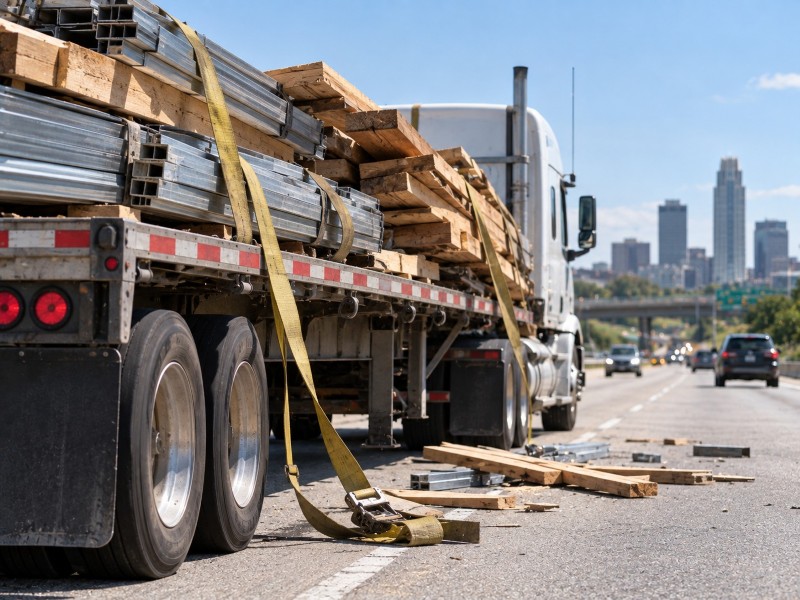
Federal regulations require cargo to be firmly immobilized or secured using tie-downs, blocking, bracing, friction mats, or other appropriate methods. The number and strength of tie-downs required depends on the weight and type of freight being hauled.
Drivers must inspect their cargo before departing and at regular intervals during the trip. If something has shifted or a tie-down has loosened, the driver must stop, correct it, and then continue. Skipping these inspections violates federal law and is a common factor in cargo-related crashes.
Weight Limits and Load Distribution Violations
Federal and state regulations cap the maximum weight a commercial truck can carry on any axle and in total. When a truck exceeds those limits, it is not just a fine. It signals that the vehicle is being operated in a way that creates serious risk for everyone on the road.
A load distribution violation occurs when freight is placed in a way that puts excessive stress on certain axles, even if the total weight is within limits. These violations can be just as dangerous as outright overloading. Law enforcement documents both types of violations during weigh station inspections and roadside checks.
Driver and Company Responsibilities Under Federal Rules
The driver is legally responsible for the load’s condition. But the trucking company and the shipper also carry responsibility for how freight is prepared and packaged before it reaches the driver. When a load distribution violation or securement failure happens, more than one party may have failed to do their job.
Inspection records, logbooks, and post-crash investigations can document violations of federal cargo rules. These records become important evidence when an injury claim moves forward.
Who Is Liable When Improper Loading Causes a Crash on I-80 in Omaha?
Liability in a cargo-related crash is rarely simple. Multiple parties can share responsibility depending on how the freight was packed, who loaded it, and what the trucking company knew before the truck left the terminal.
The Trucking Company’s Role in Cargo Claims
The trucking company often bears significant responsibility for cargo-related crashes. They hire the drivers, set the loading procedures, and maintain the equipment. If their policies allowed an overloaded semi-truck to leave the yard, or if they failed to train staff on proper loading procedures, they may be held liable for the resulting damage.
In some cases, the company knew about a recurring problem with overloading or securement failures and did nothing to correct it. That kind of knowledge, combined with inaction, strengthens the liability case.
Third-Party Liability: When the Shipper or Loader Is Responsible
Third-party liability becomes relevant when a separate company packed or loaded the freight. Many trucking arrangements involve shippers, freight brokers, and independent loading crews who never drive the truck themselves.
If the party who packed the trailer used improper stacking, ignored weight limits, or skipped required securement steps, they may share liability for the crash. A thorough investigation often involves reviewing contracts, invoices, and communications between all parties involved in the freight chain.
What Evidence Matters Most in These Cases
Building a strong claim after an I-80 truck accident in Omaha requires gathering specific types of evidence. The most valuable materials include the truck’s inspection records, the driver’s logbook, weigh-station data, loading manifests, and any photographs taken at the scene.
It’s important to focus on identifying every party whose negligence contributed to the crash. That means looking beyond the driver to the company, the shipper, and anyone else in the chain who handled the freight. In complex cargo cases, reconstruction experts and freight specialists can help establish exactly what went wrong and why.
When victims try to handle these claims without legal help, they often face large trucking companies and insurers experienced in minimizing payouts. We work to document the full picture of negligence and present it clearly.
An I-80 truck accident in Omaha involving improper cargo loading is not just a traffic incident. It results from specific choices made by specific people who had a legal duty to follow the rules. Identifying those people is the first step toward holding them accountable.
Frequently Asked Questions
How do I know if improper cargo loading caused my truck accident on I-80?
Investigating the cause of a crash requires reviewing the truck’s post-crash inspection, any weigh-station records from that trip, and the loading manifest. Physical evidence at the scene, such as scattered cargo or skid patterns, can also point to a load shift. We work with investigators who know where to look for this type of evidence.
Can the shipper be held responsible for an I-80 truck accident in Omaha?
When a shipper or independent loading crew packed the trailer improperly, they can share liability for the crash. Responsibility is not limited to the driver or trucking company. Contracts and loading records help establish who controlled the freight and whether they followed required securement standards.
What should I do after being injured in a cargo-related truck crash near Omaha?
Seeking medical attention is the most important first step, even if you feel well immediately after the crash. After that, preserving evidence matters. We can help you gather the documentation you need before records are altered or destroyed, which is a real risk in commercial trucking cases.