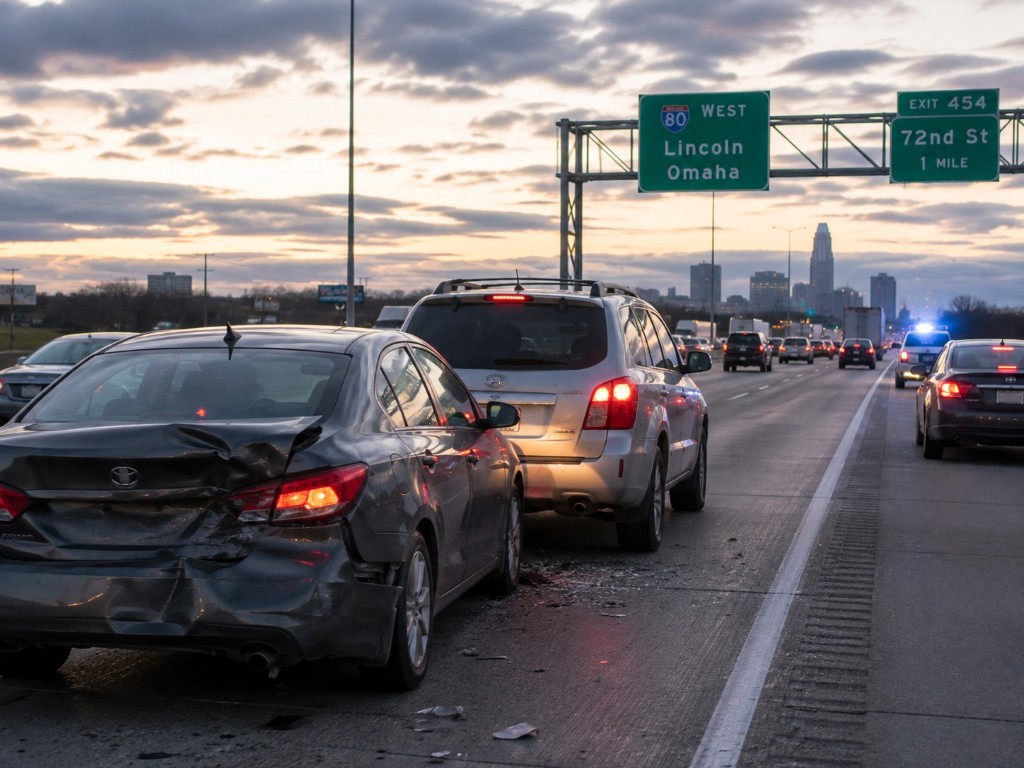
An I-80 car accident at highway speeds is rarely minor. Rear-end collisions on this stretch of interstate can shatter lives in a fraction of a second, leaving drivers and passengers with injuries that take months or years to heal. We can help injured people understand how crash evidence, fault, and damages may affect their legal options after a serious collision.
I-80 runs directly through the heart of the Omaha metro area, carrying an enormous volume of commercial trucks, commuter traffic, and long-haul drivers every single day. The combination of high speeds, heavy loads, and dense traffic creates conditions where a split-second lapse in attention can trigger a catastrophic crash. Understanding what causes these collisions and what they mean for your health and legal options matters more than most people realize until it is too late.
Why Do Rear-End Accidents Happen So Frequently at High Speeds on I-80?
I-80 is a major interstate corridor through the Omaha metro area. Several overlapping factors make rear-end collisions especially common here.
The Role of Highway Traffic Volume
Traffic density on I-80 through Omaha is consistently high during morning and evening commutes. When volume increases, drivers are forced to follow more closely, which leaves less room to react when vehicles ahead slow down or stop suddenly.
Distracted Driving at Interstate Speeds
Distracted driving is a leading cause of rear-end crashes on any highway, and I-80 near Omaha is no exception. At 70 miles per hour, a vehicle travels roughly 100 feet every second. At interstate speeds, even a brief lapse in attention can cover a substantial distance before the driver looks back at the roadway.
Truck Traffic and Stopping Distance
Commercial trucks make up a significant share of the traffic on I-80. A fully loaded semi-truck can weigh up to 80,000 pounds and requires a stopping distance far greater than a passenger vehicle. When trucks follow too closely or fail to account for changing traffic conditions ahead, the result can be a devastating rear-end crash.
What Injuries Are Most Common in High-Speed Rear-End Crashes Near Omaha?
Rear-end collision injuries at highway speeds are fundamentally different from low-speed fender benders. The forces involved in a high-speed crash can still be significant, even when safety systems like seat belts and airbags function properly.
Spinal and Neck Injuries
Whiplash is the most well-known injury from rear-end crashes, but it often gets misunderstood as a minor complaint. At interstate speeds, the rapid back-and-forth motion of the head and neck can tear ligaments, herniate discs, and compress nerves in the cervical spine.
Whiplash interstate accident injuries can take days to become fully apparent. A person may walk away from a crash feeling sore and assume they are fine, only to develop severe neck pain, numbness, and limited mobility in the days that follow. This delay in symptoms is one reason medical evaluation immediately after a crash is so important.
Traumatic Brain Injuries
When a vehicle takes a sudden, violent impact from behind, the occupant’s head can strike the headrest, steering wheel, window, or other interior surfaces. Even without a direct blow, the rapid deceleration can cause the brain to move inside the skull.
Traumatic brain injuries (TBIs) range from mild concussions to severe, life-altering damage. Symptoms such as headaches, memory problems, confusion, and mood changes after a crash should be taken seriously and documented by a medical professional. Symptoms such as confusion, memory problems, worsening headache, or other neurological changes warrant medical attention.
Orthopedic and Soft Tissue Damage
Broken bones, torn rotator cuffs, and knee injuries are also common in high-speed rear-end collisions. The force of a serious car crash can push passengers into the dashboard, door panels, or seat structures in ways that cause significant orthopedic trauma.
Soft tissue injuries, though sometimes invisible on standard X-rays, can be just as disabling as fractures. Persistent pain, limited range of motion, and the need for physical therapy or surgery are real outcomes that affect a person’s ability to work and function.
How Does Following Distance Play Into Fault After an I-80 Rear-End Collision?
Following distance is one of the most important factors in determining liability after a rear-end crash on I-80. Nebraska law requires drivers to maintain a safe distance behind the vehicle in front of them. When a driver fails to do this and causes a collision, that failure becomes a central issue in any legal claim. We may review traffic evidence and witness accounts to determine whether unsafe following distance contributed to the collision.
Tailgating Liability Under Nebraska Law
Tailgating liability under Nebraska law is grounded in the concept of negligence. A driver who follows too closely is generally considered negligent if that following distance contributed to the crash. Nebraska uses a comparative fault system, meaning fault can be shared between parties, but the rear driver often carries the primary burden when they struck the vehicle ahead.
Evidence such as dashcam footage, skid marks, witness statements, and accident reconstruction reports can all help establish what the following distance was at the time of impact.
When the Front Driver May Share Fault
Not every rear-end crash on I-80 is entirely the fault of the rear driver. A front driver who brake-checks another vehicle, changes lanes suddenly, or has non-functioning brake lights may share responsibility for what happened.
We evaluate the conduct of all involved drivers before concluding fault. A complete investigation of a highway speed crash often reveals contributing factors that are not obvious from the initial police report.
Commercial Carrier Liability
When a commercial truck is involved, liability can extend beyond the driver. Trucking companies have legal duties to maintain their vehicles, screen drivers, and enforce hours-of-service rules. If a truck driver rear-ends a passenger vehicle, the company that employed that driver may also bear responsibility. We can examine whether the truck driver, carrier, or another party may be legally responsible for the crash.
Frequently Asked Questions
How is fault determined in a rear-end collision on I-80 near Omaha?
Fault in a rear-end crash is usually established through physical evidence, witness accounts, and applicable Nebraska traffic laws. Nebraska law prohibits following another vehicle more closely than is reasonable and prudent. In a rear-end crash, investigators may examine following distance, speed, braking, lane changes, visibility, vehicle condition, and other circumstances before fault is allocated.
What should I do medically after a high-speed rear-end crash on the interstate?
Seeking medical evaluation right after the crash is the most important step, even if you feel relatively fine at the scene. Rear-end collision injuries like whiplash and traumatic brain injuries can have delayed symptoms, and a documented medical record created soon after the crash is essential for both your recovery and any legal claim you may pursue.
Can I still recover compensation if the other driver says I played a role in causing the crash?
Nebraska follows a comparative fault system, which means you may still recover compensation even if you share some degree of responsibility for what happened. Your recovery is reduced in proportion to your share of fault, as long as your portion of fault does not exceed 50 percent. We can help evaluate how comparative fault might apply to your specific situation.