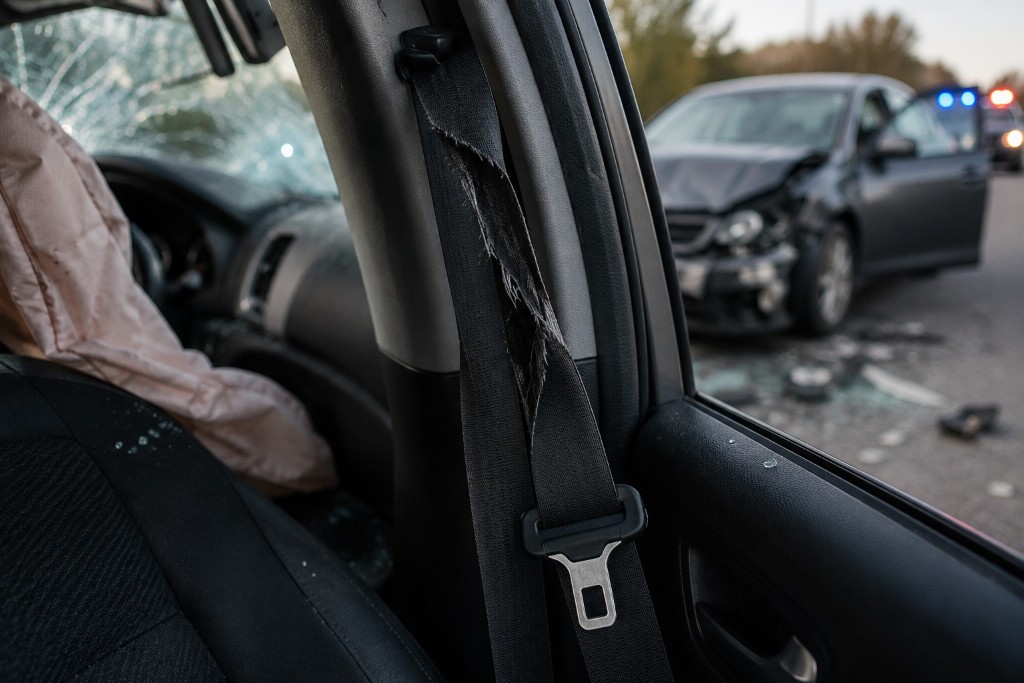
When a seatbelt fails during a crash, the consequences can be devastating. A defective auto parts car accident in Omaha often involves more than just the collision itself. The vehicle’s safety systems are supposed to protect you. When they don’t, you may have a separate legal claim against the manufacturer. An Omaha car accident lawyer can help evaluate whether the facts support a negligence claim, a product liability claim, or both.
Seatbelts save lives, but only when they work correctly. A defect hidden inside the buckle, retractor, or pretensioner can turn a survivable crash into a life-altering one. Understanding how these failures happen, and what your legal rights are in Nebraska, is the first step toward protecting yourself and your family.
What Seatbelt Defects Are Most Dangerous in a Car Crash?
Not all seatbelt failures look the same. Some happen in a fraction of a second. Others develop gradually from manufacturing errors that went undetected before the vehicle ever left the factory floor.
Buckle Defects That Release on Impact
A seatbelt buckle defect is one of the most dangerous failures a driver or passenger can experience. Some buckles are designed to unlatch during a sudden jolt. This is known as “inertial unlatching.” When the buckle releases at the moment of impact, the occupant is no longer restrained and may be thrown into the dashboard, windshield, or ejected from the vehicle entirely.
Retractor Failures That Allow Too Much Slack
A retractor failure occurs when the spool mechanism inside the seatbelt housing does not lock properly during a crash. In a functioning seatbelt, the retractor locks instantly when it senses rapid deceleration. This keeps the belt snug across the occupant’s chest and lap.
When the retractor fails, the belt feeds out too much slack. The occupant slides forward before the belt catches, dramatically increasing the risk of serious head, chest, and abdominal injuries.
Pretensioner Malfunctions That Fail to Tighten
The seatbelt pretensioner is designed to pull the belt tight at the start of a crash. It works alongside the airbag system to position the occupant correctly before the full force of impact is felt. When a pretensioner malfunctions, the occupant’s body is not held in the right position, and the airbag may actually cause harm rather than reduce it.
Pretensioner failures are often traced back to faulty sensors, defective pyrotechnic charges inside the mechanism, or poor connections between the pretensioner and the vehicle’s crash detection system. These are manufacturing and design issues, not driver errors.
Can a Seatbelt Defect Make Your Omaha Accident Case More Complicated?
A seatbelt defect does not just affect your injuries. It changes the entire legal structure of your claim. An ordinary car accident case typically involves one driver’s negligence. An occupant restraint defect adds a product liability layer that brings in the vehicle manufacturer, the parts supplier, and potentially other parties in the supply chain.
Two Claims Running at the Same Time
When a seatbelt defect contributes to your injuries, you may have two separate claims running in parallel. The first is a standard negligence claim against the at-fault driver. The second is a product liability claim against the manufacturer of the defective component. Both claims can be pursued at the same time, but they involve different legal theories, different defendants, and different evidence requirements. An Omaha car accident lawyer can help determine how these parallel claims interact and which parties may be responsible for the resulting harm.
Nebraska product liability law allows injured people to hold manufacturers responsible when a defective product causes harm. You do not need to prove the manufacturer was careless. You need to show the product was defective and that the defect caused your injuries.
How the Defense Will Try to Shift Blame
Manufacturers and their insurers rarely accept responsibility without a fight. A common defense strategy is to argue that the occupant was not wearing the seatbelt at all, or that the seatbelt worked as designed and the injuries were caused entirely by the crash forces. They may also argue that the vehicle was modified after purchase in a way that affected the belt’s performance.
This is why thorough documentation from the very beginning matters. Evidence gathered early, before parts are repaired or destroyed, gives your case the foundation it needs.
Nebraska’s Comparative Fault Rules
Nebraska follows a modified comparative fault rule. If you are found partially responsible for your injuries, your compensation may be reduced by your percentage of fault. Defense attorneys may argue that your own behavior contributed to the severity of your injuries, even in cases involving clear product defects. Understanding how this rule applies to your situation is an important part of building a complete claim.
How Do You Prove a Seatbelt Failed During Your Accident?
Proving a seatbelt defect requires more than simply saying the belt did not work. Courts and insurance companies need evidence. The type of evidence that matters most depends on which component failed and how the failure occurred.
Preserving the Physical Evidence
The most important step after any crash involving a suspected seatbelt injury claim in Nebraska is preserving the physical evidence. This means the vehicle should not be repaired, and the seatbelt assembly should not be replaced or altered until a qualified expert has inspected it. If the vehicle is totaled and sent to a salvage yard, critical evidence can be lost permanently.
Working with Accident Reconstruction and Engineering Experts
A defective auto parts car accident Omaha claim of this nature almost always requires expert testimony. Accident reconstruction specialists can analyze crash data, vehicle speed, and point of impact. Mechanical engineers who specialize in occupant restraint systems can examine the seatbelt components and testify about whether they performed within the design specifications.
These experts can also review whether similar defects have been reported in other vehicles of the same make and model. Prior complaints or recalls involving the same component can significantly strengthen a product liability claim. We can coordinate the legal investigation with qualified experts so that potentially important physical and technical evidence is properly evaluated.
Medical Records and Injury Pattern Evidence
The nature of your injuries can itself be evidence of a seatbelt failure. Certain injury patterns, such as injuries that would not be consistent with a properly restrained occupant, can support the conclusion that the belt did not perform correctly. Medical records, imaging studies, and testimony from treating physicians all contribute to building this picture.
Frequently Asked Questions
What should I do if I think my seatbelt failed during my Omaha car accident?
Photographs of the vehicle interior and restraint components can be useful if they can be obtained safely. A suspected defect should be evaluated before potentially relevant physical evidence is altered or destroyed.
How is a seatbelt defect claim different from a regular car accident claim in Nebraska?
A seatbelt defect claim is a product liability matter, which means it is brought against a manufacturer or parts supplier rather than just the at-fault driver. You can pursue both claims at the same time, but each requires different evidence and legal arguments. At Abboud Law Firm, we evaluate whether the facts support a negligence claim arising from the collision, a product-liability theory involving the restraint system, or both.
Can I still make a seatbelt defect claim if the manufacturer issued a recall on my vehicle?
An active or prior recall on your vehicle’s seatbelt components can actually support your claim by showing the manufacturer was aware of the defect. Whether you received notice of the recall or had the repair completed is a relevant factor. Still, it does not automatically eliminate your right to pursue compensation for injuries caused by the defective part.